
Woodcock Hunting
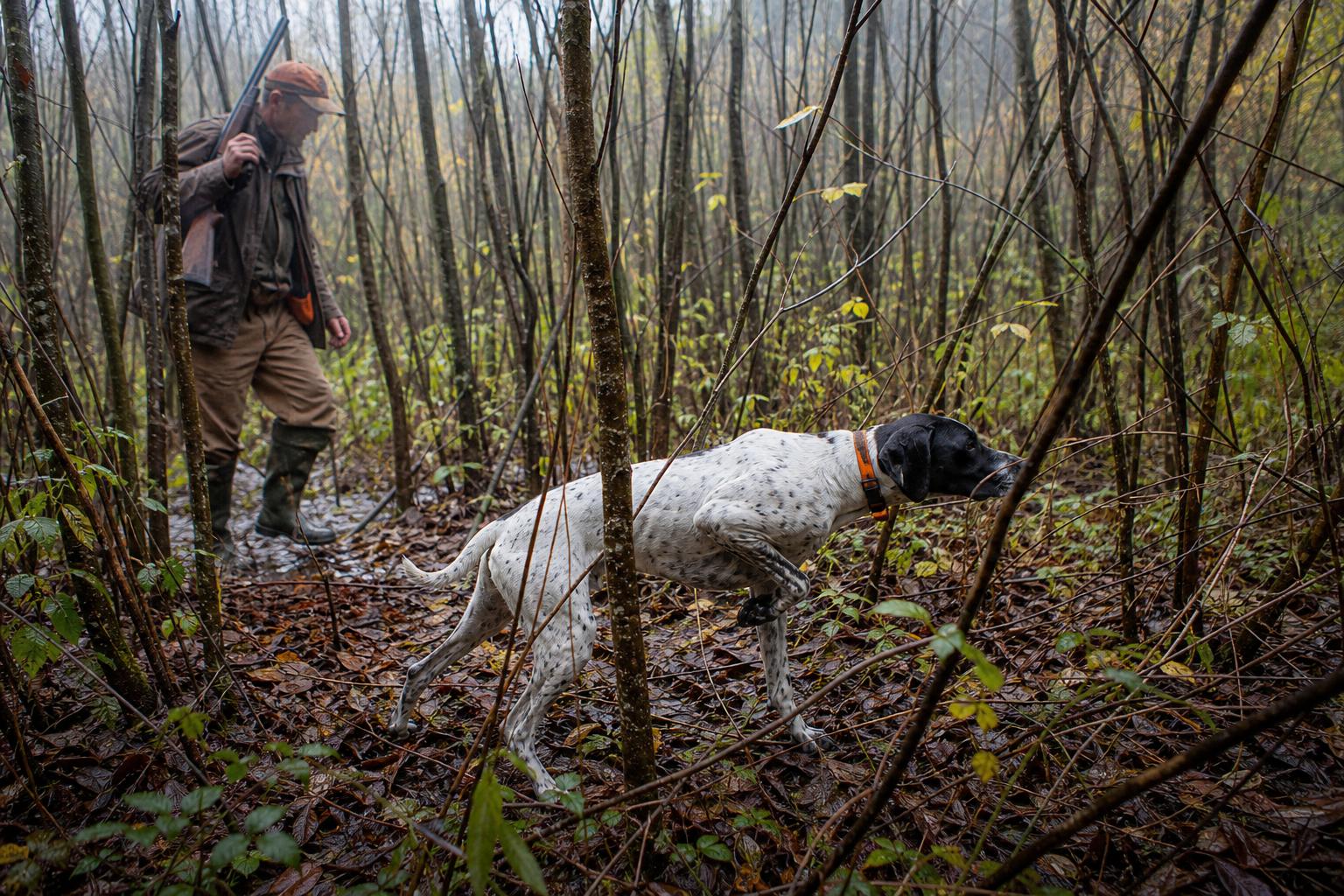
Woodcock hunting with dogs is a close-quarters, rhythm-heavy style of bird work that rewards a dog with a good nose and a steady brain. Woodcock live in damp cover—alder runs, young timber, creek bottoms, wet edges—where the ground is soft, the air holds scent in pockets, and visibility can be measured in feet rather than yards. The birds are famous for sitting tight until the last moment, then flushing with a sudden rocket-like burst that can surprise even experienced hunters. That “tight hold” is why dogs are so central. The dog turns invisible birds into predictable moments by locating them and giving the handler time to step in and prepare.
Pointing dogs are the classic partner because a firm point allows a controlled approach. But woodcock cover is dense, so the dog also needs to work at a practical range and remain composed when the handler is moving through brush. Dogs learn to hunt into the wind, slow down when scent is present, and hold steady while the handler finds a safe shooting lane. Flushers can work as well, especially for hunters who like fast action, but they need excellent stop-at-flush control because shooting lanes can be narrow and shots can be low and quick. Retrieving is also valuable. Woodcock can fall into leaf litter and wet vegetation where they disappear instantly, and a dog that can mark and recover birds cleanly makes the hunt more ethical and more efficient.
The cover teaches lessons about scent and pace. Wind can swirl in creek bottoms, and scent can hang low under heavy cover, making birds smell “everywhere” before the dog pins the exact spot. A thoughtful dog learns to tighten its pattern, work edges, and relocate carefully if the bird shifts. Handlers learn to move quietly and to trust the dog’s body language—head snaps, tail tempo, the way the dog turns into scent—because you often can’t see what the dog is seeing. Many hunters use bells in thick cover to track the dog’s position, and the sudden silence of a bell can be as informative as any GPS screen. The key is staying calm. Rushing tends to bump birds out of range and creates unsafe shooting.
Woodcock hunting is beloved because it’s intimate. You’re close to the dog, close to the cover, and close to the action. A well-trained dog makes that intimacy feel organized rather than chaotic: steady points, controlled flushes, clean retrieves. The handler’s role is to keep it safe—know your lanes, keep your muzzle up, and take honest shots—and to reinforce the dog’s steadiness so the birds aren’t constantly blown out early. When the dog locks up in a damp alder run, you step in, the bird flushes in that sudden burst, and the dog remains composed for the retrieve, you’re seeing exactly what bird dogs were made for: turning a hidden world into a readable one.
- American Brittany
- American Cocker Spaniel
- Bracco Italiano
- Braque DAuvergne
- Braque du Bourbonnais
- Braque Francais
- Cesky Fousek
- Clumber Spaniel
- Deutsch Drahthaar
- Deutsch Kurzhaar
- Deutscher Wachtelhund
- English Cocker Spaniel
- English Pointer
- English Setter
- English Springer Spaniel
- Epagneul Breton
- Field Spaniel
- French Brittany
- French Spaniel
- German Longhaired Pointer
- German Shorthaired Pointer
- German Wirehaired Pointer
- Gordon Setter
- Hungarian Vizsla
- Hungarian Wirehaired Vizsla
- Irish Red and White Setter
- Irish Red Setter
- Irish Setter
- Italian Spinone
- Kooikerhondje
- Korthals Griffon
- Large Munsterlander
- Llewellin Setter
- Portuguese Pointer
- Pudelpointer
- Saint Usuge Spaniel
- Slovakian Rough Haired Pointers
- Small Munsterlander
- Spanish Pointer
- Spinone Italiano
- Sussex Spaniel
- Weimaraner
- Welsh Springer Spaniel
- Wirehaired Pointing Griffon