
Pheasant Hunting
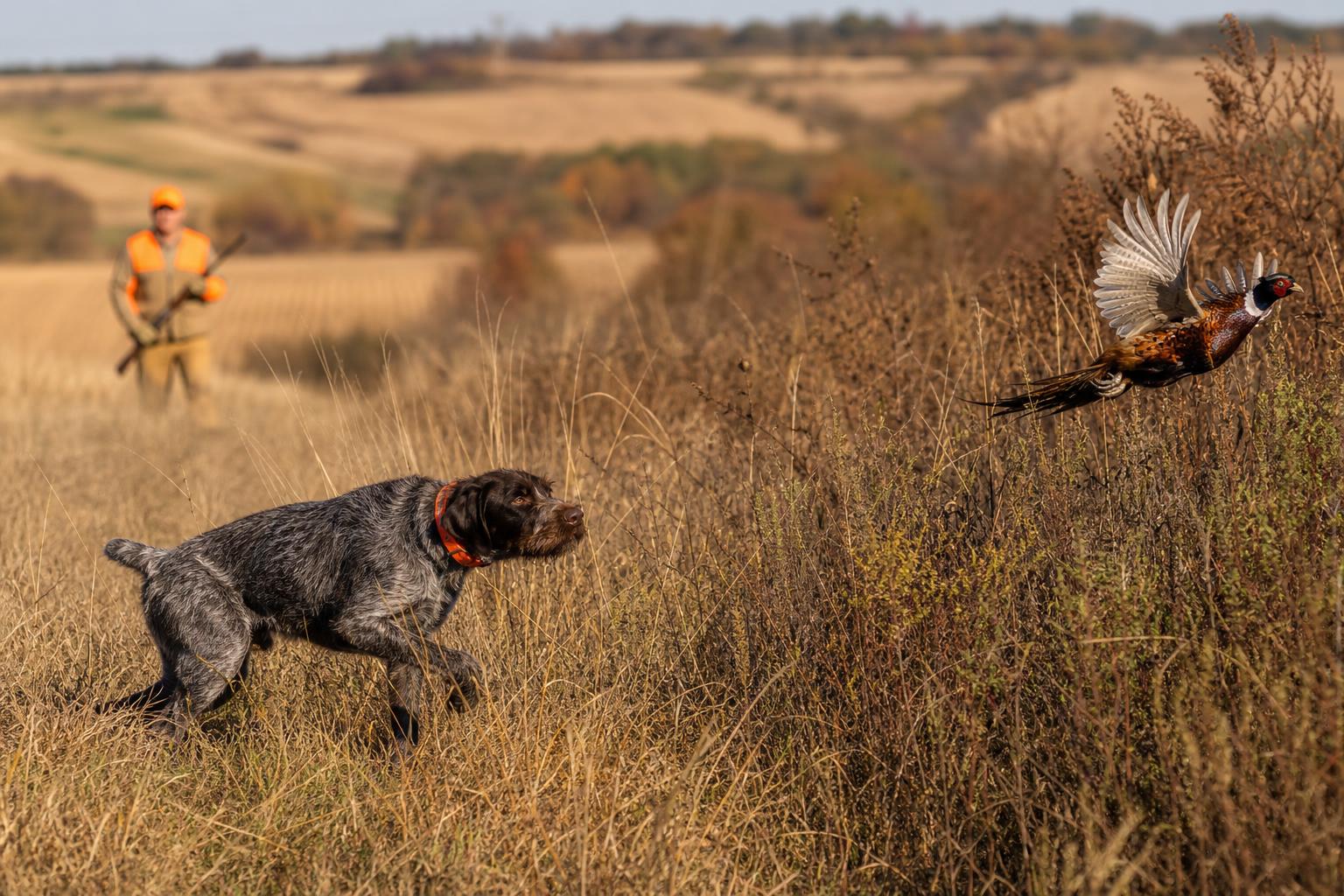
Pheasant hunting with dogs is a game of pressure, patience, and problem-solving in cover that often feels designed to defeat humans. Pheasants can run, they can hold, and they can break into long, powerful flights that punish late reactions. That’s why good dog work is so valuable. The dog helps locate birds in grass, cattails, hedgerows, CRP fields, brushy draws, and crop edges, then turns fleeting scent into a clear plan: either pin the bird for a point, push it up cleanly for a flush, or track and recover it after the shot. The best hunts don’t look like chaos. They look like controlled movement where the dog’s nose does the hard work and the humans move with purpose.
Different dogs shine in different roles. Flushers often work close, driving into heavy cover to force a bird up, then stopping on cue so hunters can shoot safely. Pointers work differently: they locate scent and lock up, aiming to hold the bird in place long enough for the handler to approach and produce a controlled flush. Retrievers add another layer, especially after the shot. A good retriever can mark a falling bird, take a straight line into thick cover, pick up gently, and deliver to hand. That recovery is often the most important part of pheasant hunting, because birds can run after being hit and disappear quickly. Dogs trained for tracking wounded birds—reading sparse scent and sign—save a lot of game that would otherwise be lost.
Pheasant cover teaches dogs and handlers to work as a unit. Wind direction matters. Cover density matters. Pace matters. If people push too fast, birds run out the end; if they move too slow, birds slip away through holes. The dog’s body language becomes the guide: a sudden head snap, a tight turn, a change in breathing, a tail that starts to flag. Skilled handlers learn to trust those cues and adjust their line. Training for pheasant work often includes steadiness, because an out-of-control dog can break safety and ruin opportunities. It also includes “hunt dead” work—teaching the dog to search an area methodically for a downed bird even when the fall wasn’t clearly seen. That kind of search is different from normal hunting; it’s more careful, closer, and more methodical.
A great pheasant dog is not just a nose on legs. It is a dog that can think in cover, adapt when birds run, and stay responsive when the excitement spikes. The best teams look calm because they’ve built routines: how to enter cover, how to handle at the flush, how to send on a retrieve, how to stop a chase, and how to reset for the next push. When that partnership is in place, pheasant hunting becomes safer and more rewarding. The dog finds birds you would never find on your own, retrieves birds you might never recover, and turns a hard, brushy landscape into a place where you can hunt efficiently and ethically.
- American Brittany
- American Cocker Spaniel
- Bracco Italiano
- Braque DAuvergne
- Braque du Bourbonnais
- Braque Francais
- Cesky Fousek
- Clumber Spaniel
- Deutsch Drahthaar
- Deutsch Kurzhaar
- Deutscher Wachtelhund
- English Cocker Spaniel
- English Pointer
- English Setter
- English Springer Spaniel
- Epagneul Breton
- Field Spaniel
- French Brittany
- French Spaniel
- German Longhaired Pointer
- German Shorthaired Pointer
- German Wirehaired Pointer
- Gordon Setter
- Hungarian Vizsla
- Hungarian Wirehaired Vizsla
- Irish Red and White Setter
- Irish Red Setter
- Irish Setter
- Italian Spinone
- Kooikerhondje
- Korthals Griffon
- Large Munsterlander
- Llewellin Setter
- Portuguese Pointer
- Pudelpointer
- Saint Usuge Spaniel
- Slovakian Rough Haired Pointers
- Small Munsterlander
- Spanish Pointer
- Spinone Italiano
- Sussex Spaniel
- Weimaraner
- Welsh Springer Spaniel
- Wirehaired Pointing Griffon