
Grouse Hunting
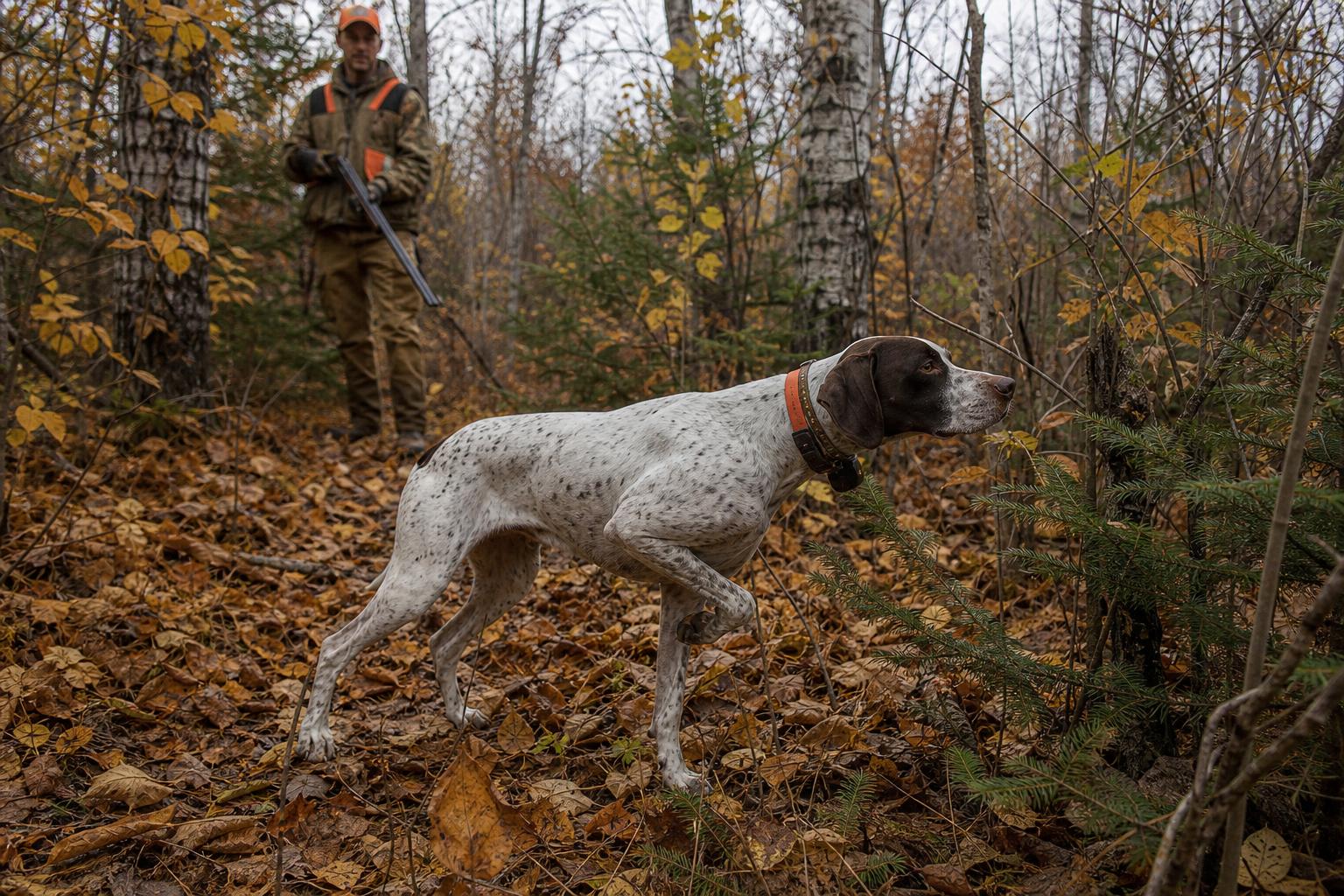
Grouse hunting with dogs is often described as the most honest kind of bird work because the woods expose every weakness in training and handling. Grouse live in cover where visibility is limited, shooting lanes appear and vanish in a second, and the dog’s nose does most of the work before the human even realizes birds are present. Depending on region, that can mean ruffed grouse in mixed timber and thick understory, spruce grouse in northern cover, or other woodland birds with their own habits. The dog’s job is to locate birds, manage scent in swirling forest air, and create a moment where the hunter can step in and take a safe shot—if one exists. The best hunts feel quiet. You hear leaves and footfalls. Then you see the dog’s posture change, the pace tighten, and suddenly the woods erupt.
Different dogs approach grouse in different styles. Pointing dogs are prized because a solid point can buy the hunter a second to position for a shot and to move carefully through brush. But grouse are famous for “wild flushes” and nervous holds, so a dog also needs judgment. Sometimes the correct move is to stand rock-still. Sometimes it’s to relocate slowly and re-pin. Flushers can work too, especially in cover where birds sit tight, but they require excellent control at the flush so the dog doesn’t blow through shooting lanes. Retrieving matters after the shot, because downed birds can disappear into leaf litter and tangled vegetation. A dog that can mark a fall, track scent carefully, and deliver gently saves birds that humans would otherwise lose.
The woods make scent tricky. Wind is inconsistent, and scent can pool in low spots or get carried up and over ridges. Birds may sit in one place and let scent drift, creating a confusing picture. Dogs learn to slow down, to work edges, and to trust tiny scent clues. Handlers learn to trust the dog’s body language more than their own assumptions. Pace becomes strategic. Move too fast and you bump birds out of range. Move too slow and you lose your window. Many hunters use bells or GPS to keep track of the dog because dense cover makes visual contact unreliable. But even with tools, the essential skill is reading the dog: when it’s hunting, when it’s in scent, when it’s uncertain, and when it’s committed.
What makes grouse hunting special is how it rewards steadiness and partnership over spectacle. A dog that is frantic will bump birds and create unsafe shots. A dog that is thoughtful will produce cleaner opportunities and keep the hunt controlled. The handler’s role is to keep things safe—muzzle awareness, clear shooting lanes, and honest shot selection—and to support the dog with calm movement and clear cues. When a good bird dog points a grouse deep in the timber, holds through your approach, and then the bird flushes exactly where you have a safe shot, it feels like a small miracle. In truth, it’s training, experience, and the dog’s nose doing what it was built to do in the hardest classroom there is: the woods.
- American Brittany
- American Cocker Spaniel
- Bracco Italiano
- Braque DAuvergne
- Braque du Bourbonnais
- Braque Francais
- Cesky Fousek
- Clumber Spaniel
- Deutsch Drahthaar
- Deutsch Kurzhaar
- Deutscher Wachtelhund
- English Cocker Spaniel
- English Pointer
- English Setter
- English Springer Spaniel
- Epagneul Breton
- Field Spaniel
- French Brittany
- French Spaniel
- German Longhaired Pointer
- German Shorthaired Pointer
- German Wirehaired Pointer
- Gordon Setter
- Hungarian Vizsla
- Hungarian Wirehaired Vizsla
- Irish Red and White Setter
- Irish Red Setter
- Irish Setter
- Italian Spinone
- Kooikerhondje
- Korthals Griffon
- Large Munsterlander
- Llewellin Setter
- Portuguese Pointer
- Pudelpointer
- Saint Usuge Spaniel
- Slovakian Rough Haired Pointers
- Small Munsterlander
- Spanish Pointer
- Spinone Italiano
- Sussex Spaniel
- Weimaraner
- Welsh Springer Spaniel
- Wirehaired Pointing Griffon