
Chukar Hunting
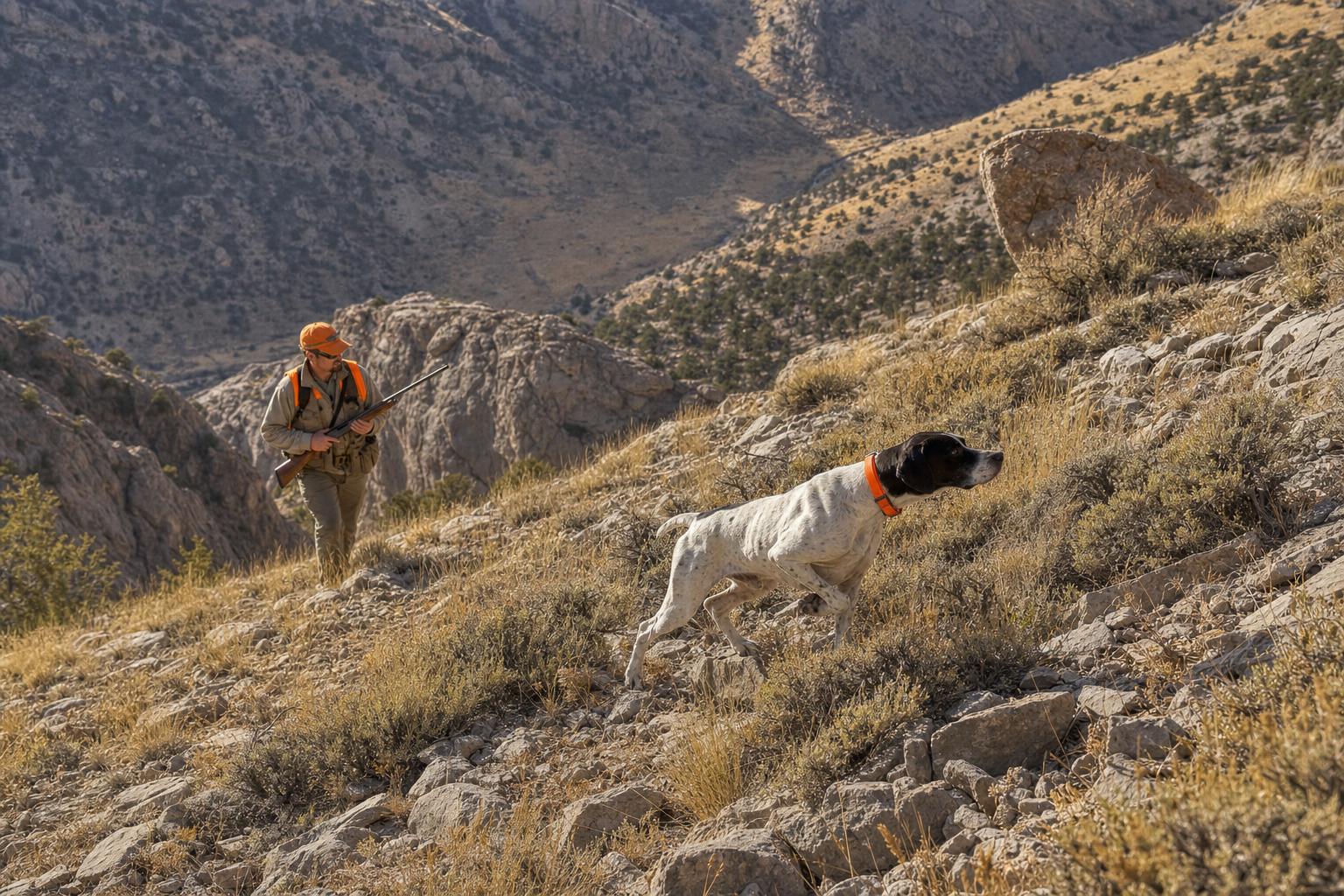
Chukar hunting with dogs is often described as equal parts bird work and mountain climbing. Chukar live in steep, rocky terrain—rimrock, scree slopes, canyons, and open hillsides—where footing is unstable and the birds use elevation like a weapon. They run uphill, they hold in pockets, and when they flush they can sail downhill a long way. That means the dog’s job isn’t just finding birds; it’s finding birds in a place that punishes inefficiency. A good dog helps the hunter cover country intelligently, locate birds that would otherwise be invisible in rocks and sage, and create workable flushes without blowing coveys out of the zip code.
Pointing dogs are the classic fit because a solid point can stop the chase game and give the hunter a chance to approach. But chukar are notorious runners, so the dog also needs relocation skill—moving carefully to re-pin birds that have shifted. That relocation should be controlled, not a sprint, because fast pressure often makes chukar flush wild. Flushers can work too, but they require tight control and a hunter who accepts quick, close shots. Retrieving matters because downed birds can tumble into rocks and brush where humans struggle to reach. A dog that can mark a fall and navigate to the bird saves time and prevents lost game.
The terrain creates real safety and conditioning demands. Dogs need tough feet, strong joints, and endurance. Pads can shred on lava rock or sharp shale. Heat can be intense, and water can be scarce. Good handlers condition dogs before season, carry water, and manage rest carefully. They also pay attention to slope hazards and to the dog’s willingness. A dog that starts to lose traction or confidence on a slope can get injured. Scent behavior is different in the open too. Wind can be strong and consistent, which helps, but it can also swirl in canyons and push scent far from birds. Dogs learn to cast into wind, to use high points to sample air, and to tighten their search when they hit a covey’s scent cone.
What makes chukar hunting with dogs so satisfying is that it turns a hard day into a smart day. Instead of marching blindly up a hill, you watch the dog’s pattern and let the nose guide where you spend effort. When the dog locks up on a steep slope, holds while you climb in, and then the covey flushes within range, the whole thing feels earned. It is earned—by the dog’s conditioning, by the dog’s nose, by training that produced steadiness and controlled relocation, and by a handler who planned for the terrain rather than fighting it. Chukar hunting is demanding, but with the right dog it becomes a partnership challenge instead of a punishment hike.
- American Brittany
- Bracco Italiano
- Braque DAuvergne
- Braque du Bourbonnais
- Braque Francais
- Cesky Fousek
- Deutsch Drahthaar
- Deutsch Kurzhaar
- English Pointer
- English Setter
- Epagneul Breton
- French Brittany
- German Longhaired Pointer
- German Shorthaired Pointer
- German Wirehaired Pointer
- Gordon Setter
- Hungarian Vizsla
- Hungarian Wirehaired Vizsla
- Irish Red and White Setter
- Irish Red Setter
- Irish Setter
- Italian Spinone
- Korthals Griffon
- Large Munsterlander
- Llewellin Setter
- Portuguese Pointer
- Pudelpointer
- Slovakian Rough Haired Pointers
- Small Munsterlander
- Spanish Pointer
- Spinone Italiano
- Weimaraner
- Wirehaired Pointing Griffon