
Wilderness SAR
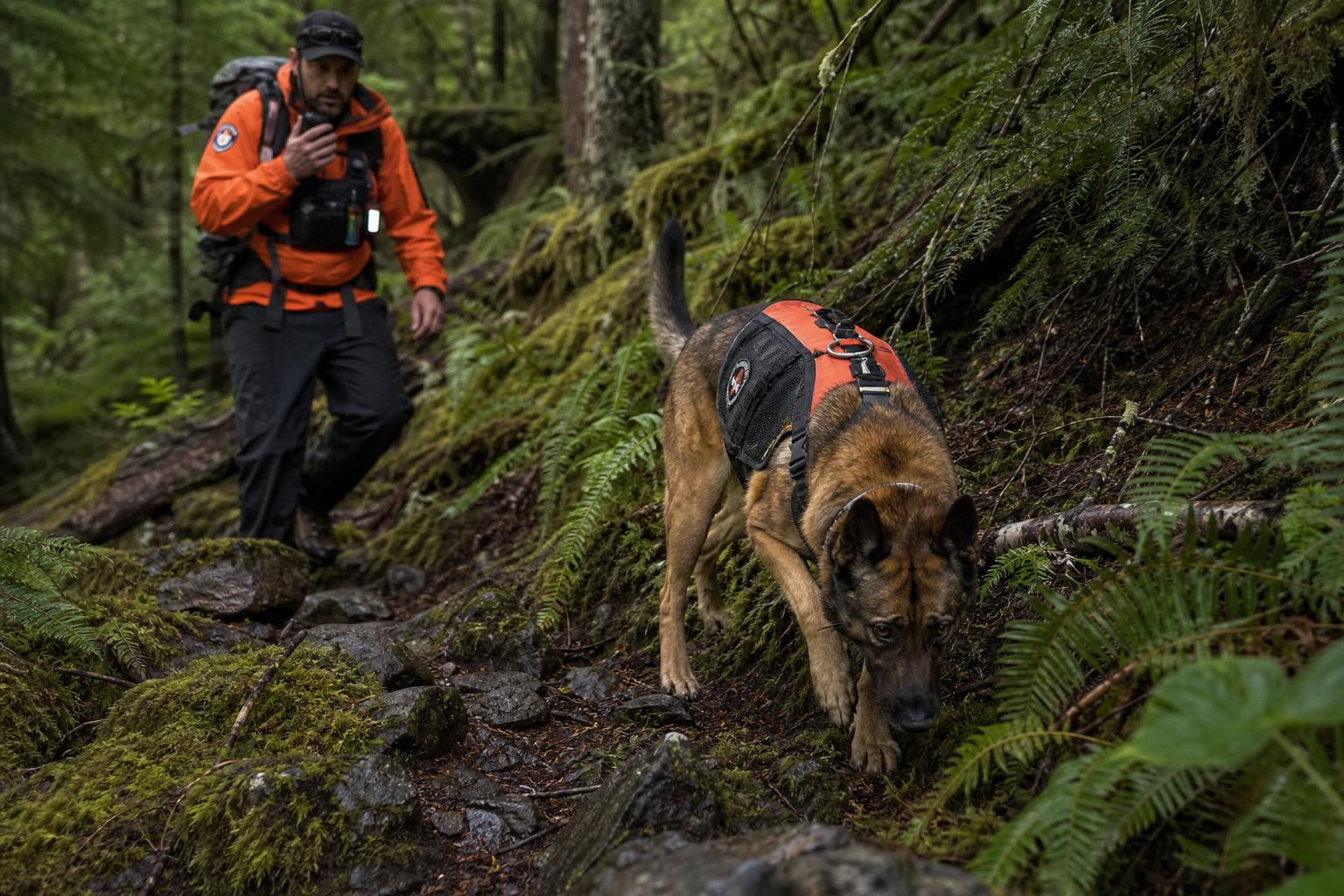
Wilderness SAR focuses on finding missing people in natural terrain—forests, fields, mountains, swamps, deserts, and everything in between. The search environment is rarely tidy. Scent moves with wind, pools in low spots, gets shredded by vegetation, and changes with time of day. Visibility can be poor, footing can be dangerous, and weather can shift quickly. A capable dog can cover ground efficiently and detect human scent far beyond what a person can perceive, but the work depends on a team approach: the dog provides detection power, and the handler provides strategy, safety, and interpretation.
Dogs trained for wilderness searches develop a particular kind of persistence. They learn to range, to quarter into the wind, to check terrain features, and to stay on task for long periods. They also learn to communicate findings clearly—typically through a bark alert at the subject, a recall-refind pattern, or another trained indication that works at distance. Whatever the indication, it must be obvious and repeatable, because the handler may be hundreds of feet away when the dog locates scent. Training plans build desire to search through games and reward history, then layer in proofing so the dog can work around wildlife, other people, other dogs, and countless environmental distractions. Teams also practice “no find” searches, because operational reality includes long missions where there may be nothing to locate.
Handlers train just as hard. They study mapping, navigation, radio procedure, incident command, terrain, and basic medical response. They learn how to read wind and scent behavior, and they learn how to read their own dog—subtle changes in breathing, pace, and head movement that signal odor presence. They also manage the dog’s body: hydration, heat management, paw care, recovery, and fatigue. Wilderness work is physically demanding. A dog that is unconditioned can get injured or burn out. A handler who doesn’t plan rest, water, and safe routes can create problems rather than solving them.
When wilderness SAR is done well, it has a steady rhythm. The dog hunts with purpose, covering ground without wasting motion, adjusting to terrain and airflow like it is solving an invisible puzzle. The handler follows, watching for the moment the search pattern shifts—when the dog catches odor and tightens the hunt. That moment is the reason the work exists. It turns a huge, intimidating landscape into a manageable search problem, and it gives teams a real chance to locate someone quickly. It is serious work, but it is also one of the most meaningful jobs a dog can do: using instinct, training, and partnership to bring someone home.