Agility
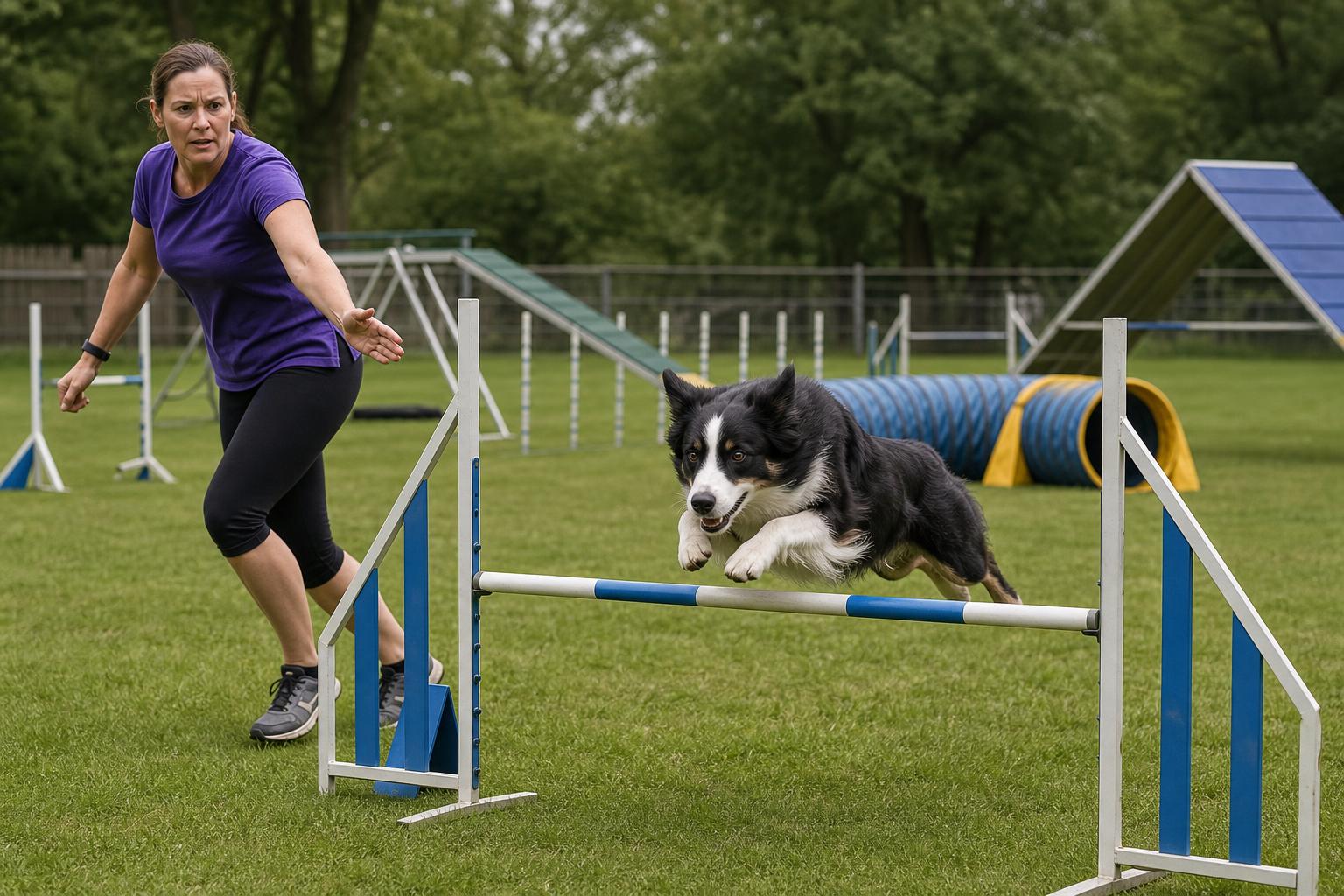
Agility is obstacle-based teamwork where a dog runs a course of jumps, tunnels, contact equipment, and weave poles under the guidance of a handler. It’s easy to describe as “a dog running fast,” but the real skill is communication at speed. The handler is giving information with body position, timing, and cues while moving, and the dog is making split-second decisions about lines, turns, and commitment. When a team clicks, it looks like choreography—tight turns, confident contacts, clean weaves, and a dog that stays glued to the handler’s direction without losing enthusiasm.
Building that kind of performance starts long before a dog ever sees a full-height jump. Foundation work teaches the dog how to learn: how to follow motion, how to respond to a marker, how to offer focus, how to reset after mistakes. It also teaches safety. Dogs learn body awareness through balance work and stride regulation. They learn how to drive forward into a tunnel and how to collect for a turn. Contacts are trained so the dog understands a criterion—hit a zone, hold position, release on cue—rather than guessing. The weave poles are their own project: repetition, confidence, and rhythm, built carefully so the dog never feels trapped or frantic.
Agility also teaches handlers humility. A late cue is a wrong cue, and the course doesn’t care about your intentions. So teams practice handling patterns: front crosses, rear crosses, blind crosses, sends, threadles, wraps. They learn to read the dog’s commitment point and to communicate earlier than feels necessary. Training sessions are often short and thoughtful: a few reps of one skill, then a break. Too many full courses can build stress and sloppiness. Good programs alternate speed days with precision days. They also build resilience to trial environments—crating, loudspeakers, waiting, ring entrances—because a dog that runs beautifully in practice can fall apart if the overall day is confusing.
What makes agility special is that it blends joy and structure. Many dogs love the movement and the rewards. Many handlers love the problem-solving. It can be competitive, but it can also be a fantastic outlet for high-energy breeds, a confidence builder for sensitive dogs, and a relationship builder for anyone who wants a sport that feels like play with rules. Done well, agility produces a dog that is athletic, responsive, and mentally engaged—and a handler who has learned how to communicate clearly while moving fast.
- Australian Cattle Dog
- Australian Koolie
- Australian Shepherd
- Bearded Collie
- Beauceron
- Belgian Malinois
- Belgian Sheepdog
- Belgian Tervuren
- Border Collie
- Bouvier des Flandres
- Briard
- Canaan Dog
- Cardigan Welsh Corgi
- Collie
- Entlebucher Mountain Dog
- Finnish Lapphund
- German Shepherd
- Icelandic Sheepdog
- Norwegian Buhund
- Old English Sheepdog
- Papillon
- Pembroke Welsh Corgi
- Polish Lowland Sheepdog
- Poodle
- Puli
- Pyrenean Shepherd
- Shetland Sheepdog
- Swedish Vallhund
- Toy American Eskimo