Tracking Dogs
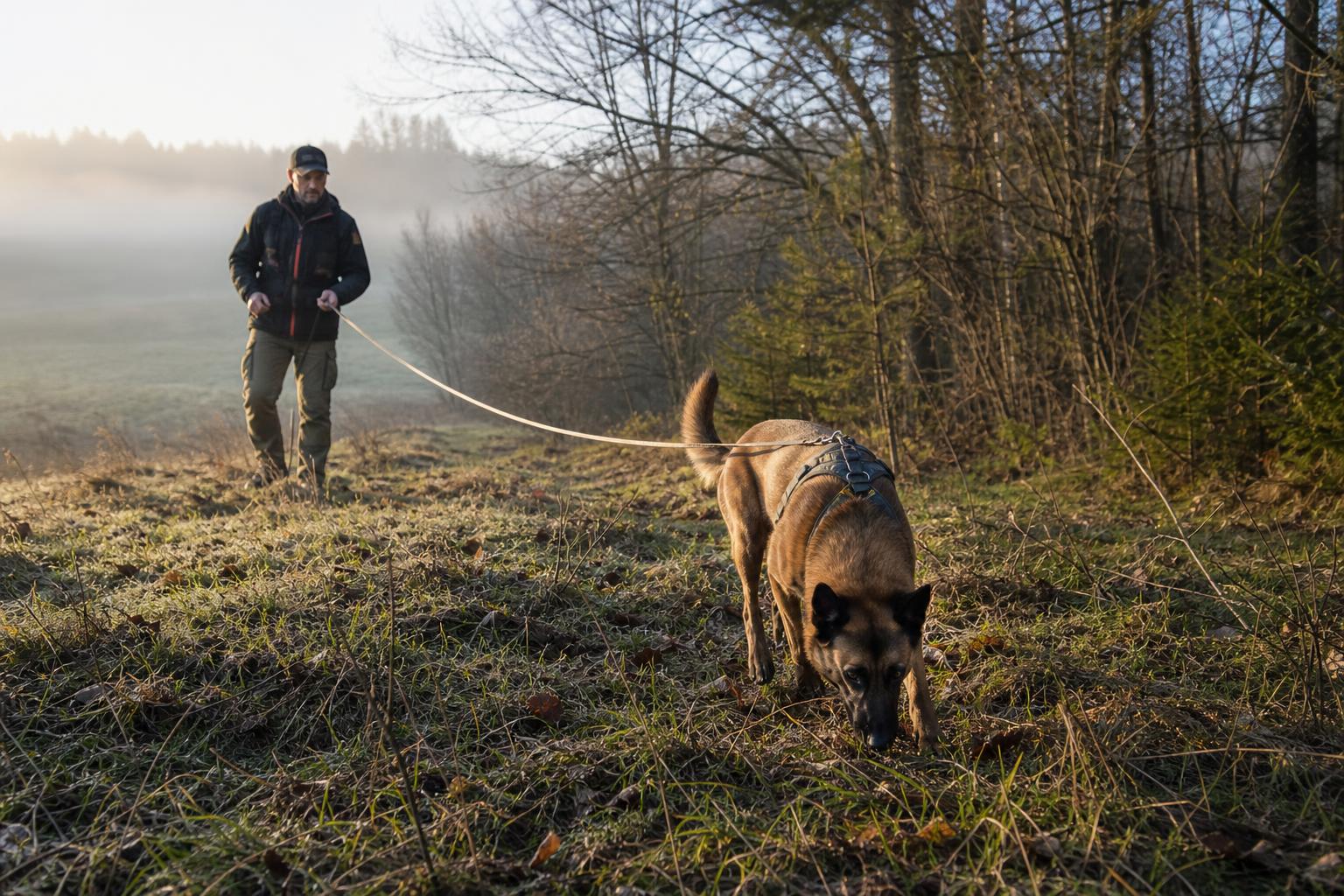
Tracking dogs are highly specialized working dogs trained to follow the scent trail of a person or animal across a wide variety of terrain and environmental conditions. Using their extraordinary sense of smell, these dogs can locate wounded game, missing persons, fugitives, or lost animals by carefully following ground disturbance, human scent particles, and airborne odor carried along a trail. Their ability to detect and interpret scent makes them some of the most valuable and versatile working dogs in the world.
Unlike chase dogs that pursue game at speed, tracking dogs work methodically and with purpose, focusing on staying connected to a specific scent trail even when conditions become difficult. A skilled tracking dog can follow tracks through forests, swamps, rocky terrain, fields, snow, or urban environments while ignoring countless distractions and crossing scents. Depending on training and the type of work, some tracking dogs keep their noses close to the ground, while others use a combination of ground scent and drifting airborne odor to advance the trail.
Tracking dogs are widely used in hunting, law enforcement, military operations, and search-and-rescue work. In the hunting world, they are often relied upon to recover wounded deer, bear, or other game animals that might otherwise be lost. In police and military roles, tracking dogs help locate fleeing suspects, missing individuals, or evidence tied to a trail. Search-and-rescue teams use tracking dogs to help find lost hikers, disaster victims, and vulnerable individuals in challenging conditions where human search efforts alone may fail.
Many breeds excel at tracking work due to their scenting ability, intelligence, endurance, and trainability. Popular tracking breeds include Bloodhound, German Shepherd, Belgian Malinois, Black and Tan Coonhound, and Beagle. However, many successful tracking dogs come from working-line crosses or individual dogs with exceptional natural scenting instincts regardless of breed.
A great tracking dog combines nose, discipline, patience, and mental focus. These dogs must remain calm and methodical even when a trail becomes faint, contaminated, or hours old. Handlers learn to read subtle body language—changes in posture, breathing, tail movement, or pace—to understand how the dog is interpreting the scent trail ahead.
For hunters, handlers, and working-dog professionals, tracking dogs represent one of the purest examples of the canine nose at work. Their partnership with humans is built on trust, communication, and instinct, allowing dogs to accomplish tasks that would be nearly impossible through human senses alone.
- Airedale
- American Brittany
- American Cocker Spaniel
- American Foxhound
- American Water Spaniel
- Artois Hound
- Barbet
- Basset Bleu de Gascogne
- Basset Fauve de Bretagne
- Basset Hound
- Bavarian Mountain Hound
- Beagle
- Beagle-Harrier
- Berner Laufhund
- Bloodhound
- Boykin Spaniels
- Bracco Italiano
- Braque DAuvergne
- Braque du Bourbonnais
- Braque Francais
- British Labrador Retriever
- Cesky Fousek
- Chesapeake Bay Retriever
- Clumber Spaniel
- Curly Coated Retriever
- Deutsch Drahthaar
- Deutsch Kurzhaar
- Deutscher Wachtelhund
- English Cocker Spaniel
- English Foxhound
- English Pointer
- English Setter
- English Springer Spaniel
- Epagneul Breton
- Field Spaniel
- Finnish Hound
- Flat Coated Retriever
- French Brittany
- French Spaniel
- German Longhaired Pointer
- German Shorthaired Pointer
- German Wirehaired Pointer
- Golden Retriever
- Gordon Setter
- Grand Bleu de Gascogne
- Hamiltonstovare
- Hanover Hound
- Harrier
- Hungarian hound
- Hungarian Vizsla
- Hungarian Wirehaired Vizsla
- Irish Red and White Setter
- Irish Red Setter
- Irish Setter
- Irish Water Spaniel
- Italian Spinone
- Kooikerhondje
- Korthals Griffon
- Labrador Retriever
- Lagotto Romagnolo
- Large Munsterlander
- Llewellin Setter
- Miniature Dachshund
- Nova Scotia Duck-Tolling Retriever
- Poodle
- Porcelaine
- Portuguese Pointer
- Portuguese Water Dog
- Pudelpointer
- Saint Usuge Spaniel
- Serbian Tricolor Hound
- Slovakian Rough Haired Pointers
- Small Munsterlander
- Spanish Pointer
- Spanish Water Dog
- Spinone Italiano
- Sussex Spaniel
- Weimaraner
- Welsh Springer Spaniel
- Wirehaired Pointing Griffon