Treibball
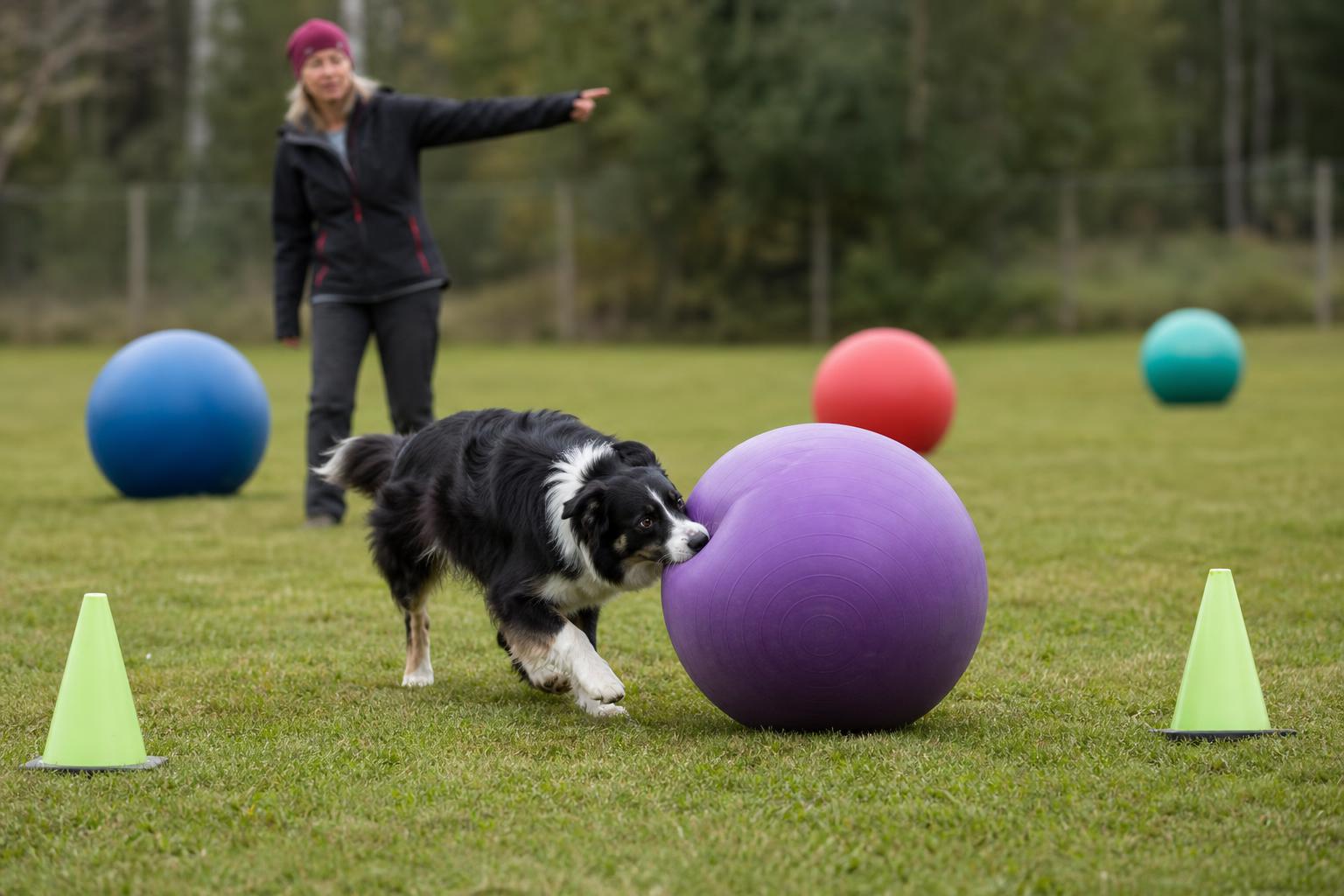
Treibball is a modern herding-style sport where a dog learns to move large exercise balls—often called “sheepballs”—into a goal under the handler’s direction. It was originally popularized as a low-impact outlet for herding breeds that crave control-and-movement work but may not have regular access to livestock. The game looks simple: push balls, score points. The reality is that it requires the same core ingredients that make stock work beautiful—distance control, thoughtful pressure, directional cues, and a dog that can stay connected while working independently. Because the “stock” is a ball, the sport becomes accessible in parks and backyards, and it can be adapted for dogs that shouldn’t do high-impact running sports.
Training typically starts with a clear push behavior. Many teams teach a nose target to the ball, then shape it into a purposeful push with forward motion rather than random nudging. From there, the dog learns to push on cue and to stop on cue, because stopping is what makes steering possible. Handlers then introduce directional control: left, right, go out, bring it in. The dog learns to work at a distance from the handler, taking cues while facing away, which can be surprisingly challenging for dogs that are used to looking up for direction. Good training breaks this into small wins—one ball, short distances, clear lines—then gradually adds complexity: multiple balls, longer sends, obstacles, and time limits. Because the ball moves differently depending on surface and slope, dogs also learn to adjust. A good treibball dog doesn’t just push; it reads where the ball is going and corrects its line.
One of the strengths of treibball is that it rewards thoughtful pacing. A frantic dog will overshoot, slam into balls, or get stuck in loops. A dog that can slow down and problem-solve will score more consistently and stay safer. Handlers often spend as much time training arousal management as they do training ball pushes: settle before starting, wait for release, pause and reset between balls, and finish with calm. This matters because the sport can easily turn into a chaotic chase game if foundations are skipped. It also matters for the dog’s body. Controlled pushing and controlled turns are safer than repeated high-speed collisions. Many teams pair treibball with conditioning exercises that build core strength and body awareness so the dog can pivot and brace without strain.
Done well, treibball becomes a satisfying job for dogs that like to control movement and for handlers who enjoy strategy. It also has a nice side effect: it teaches communication at a distance. The dog learns to listen, to take direction, and to work independently without disconnecting. For herding-breed owners, that can translate into better impulse control in daily life—less staring, less chasing, more ability to “work with you” instead of inventing a job. And for many teams, it’s simply fun: the dog gets to use its brain, the handler gets to run a plan, and the whole thing feels like a teamwork puzzle you can set up almost anywhere.
- Australian Cattle Dog
- Australian Koolie
- Australian Shepherd
- Bearded Collie
- Beauceron
- Belgian Malinois
- Belgian Sheepdog
- Belgian Tervuren
- Border Collie
- Bouvier des Flandres
- Briard
- Canaan Dog
- Cardigan Welsh Corgi
- Collie
- Entlebucher Mountain Dog
- Finnish Lapphund
- German Shepherd
- Icelandic Sheepdog
- Norwegian Buhund
- Old English Sheepdog
- Pembroke Welsh Corgi
- Polish Lowland Sheepdog
- Puli
- Pyrenean Shepherd
- Shetland Sheepdog
- Swedish Vallhund