
Cattle Herding
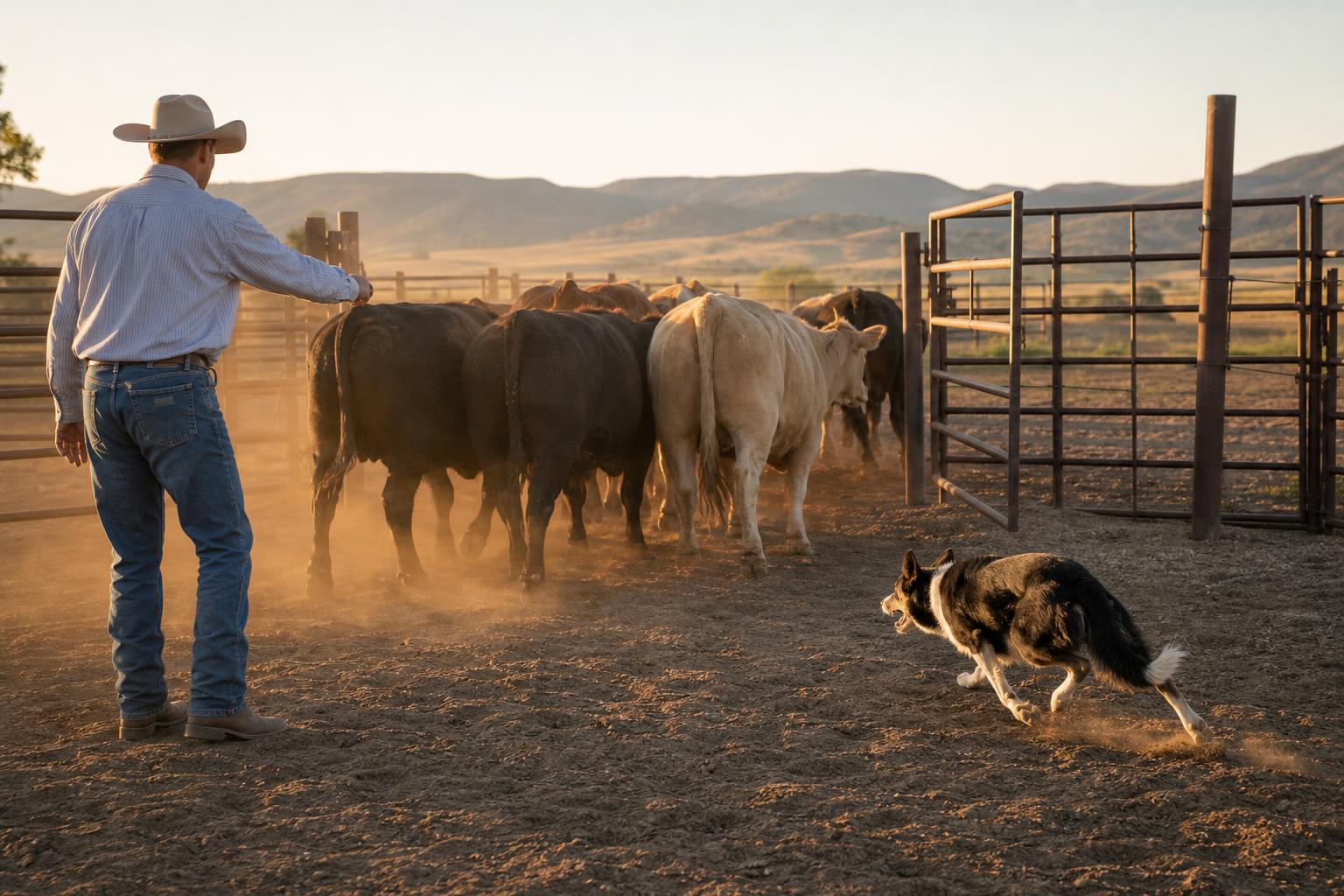
Cattle herding is the work of moving and controlling cattle with a dog in a way that is safe, effective, and respectful of the animals’ power. Cattle are not sheep. They are larger, often more stubborn, and more willing to challenge pressure rather than flee from it. That changes what you ask of a dog. A dog working cattle needs confidence and presence. It needs enough push to move a reluctant animal, but also enough judgment to avoid reckless grips and dangerous positioning. Done well, the work looks deliberate: the dog holds a line, blocks escapes, and steps into pressure with timing that moves cattle without starting a fight. On working ranches, that can mean sorting animals, moving them through alleys, holding a gate, or pushing a group into a pen or trailer.
Training begins with control and clarity. The dog must have a reliable stop, a recall off livestock, and a willingness to take direction. Without that, cattle work becomes risky quickly. Many programs start on calmer, dog-broke cattle and in confined spaces where the handler can support the dog. The dog learns where to apply pressure—often at the shoulder or head—to turn an animal, and how to stay out of kicking range. It learns to read when a cow is about to break past it and how to block without overcommitting. Some styles include gripping, but grips should be trained carefully and used with purpose, not as a default. A dog that grips out of frustration creates chaos and can get hurt. A dog that grips with timing can move a stubborn animal when nothing else works.
As the dog becomes more capable, the work expands to real ranch tasks: sorting in a pen, holding the herd on a fence line, pushing a group down an alley, separating a single animal from the group, and holding pressure while humans move in to work. These are complex problems. Cattle pressure can ripple through a herd; move one animal, the group shifts. Dogs learn to cover the “hole” where cattle will escape. They learn to bite less and think more. Handlers learn to position themselves so the dog has support and a clear job, because cattle work is often a three-body problem: stock, dog, handler. Good handling creates angles that let the dog do its work without getting overfaced.
A good cattle dog is valued because it makes hard work safer and more efficient. It reduces the need for rough handling and can move cattle with less stress when used correctly. But it’s not a role for every dog, and it’s not a role for sloppy training. The dog must be physically sound, mentally tough, and guided by a handler who understands livestock and understands the dog’s limits. When those pieces are in place, cattle work becomes a vivid example of controlled power: a dog that can step up to a thousand-pound animal with confidence, move it where it needs to go, and then turn right back to the handler for the next cue—calm, clear, and ready.
- Australian Cattle Dog
- Australian Koolie
- Australian Shepherd
- Bearded Collie
- Beauceron
- Belgian Malinois
- Belgian Sheepdog
- Belgian Tervuren
- Blackmouth Cur
- Blue Lacy
- Border Collie
- Bouvier des Flandres
- Briard
- Canaan Dog
- Cardigan Welsh Corgi
- Catahoula Cur
- Collie
- Entlebucher Mountain Dog
- Finnish Lapphund
- Florida Cracker Cur
- German Shepherd
- Icelandic Sheepdog
- Mountain Cur
- Mountain View Cur
- Norwegian Buhund
- Old English Sheepdog
- Pembroke Welsh Corgi
- Polish Lowland Sheepdog
- Puli
- Pyrenean Shepherd
- Shetland Sheepdog
- Stephens Cur
- Swedish Vallhund
- Tennessee Treeing Brindle
- Treeing Cur