
Herding
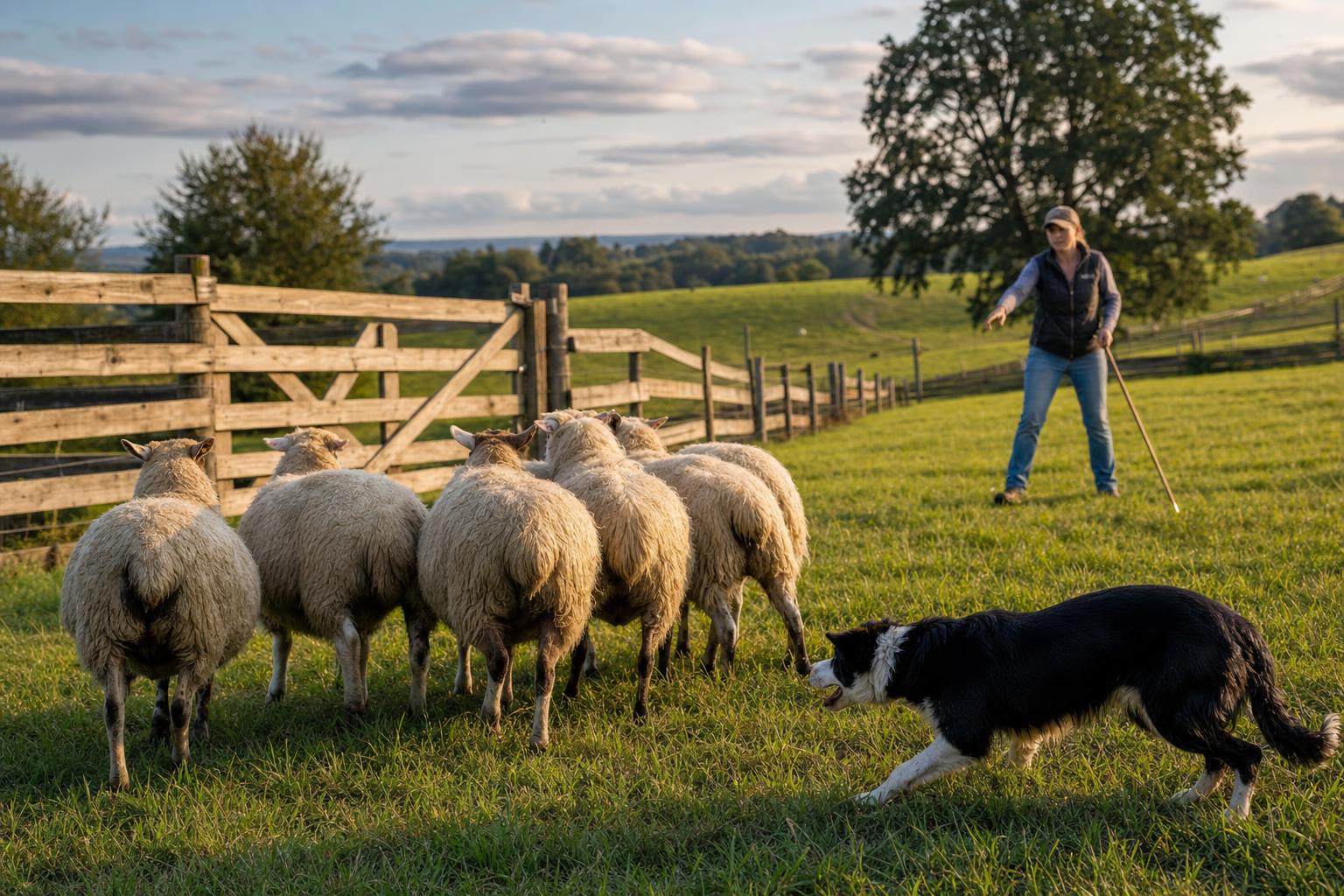
Herding work is the craft of teaching a dog to move livestock with control, intention, and respect. It can happen on a working farm where the dog helps move sheep or cattle from pasture to pen, or it can happen in a trial field where the work is judged against set tasks. Either way, the heart of it is partnership and pressure management. The dog applies pressure with body position, eye, and movement to influence the stock. The handler shapes that pressure into a plan: gather, drive, pen, sort, hold. A good herding dog doesn’t just chase. It thinks. It reads animals, adjusts distance, and keeps motion calm enough that livestock move efficiently rather than panicking. When people first see it done well, it can look like mind-reading. In reality it’s instinct refined by training and a lot of small decisions made correctly at speed.
Training begins by channeling instinct into usable patterns. Many herding breeds naturally want to control movement—some by eye and stalk, some by heel nipping, some by upright presence. The goal isn’t to erase those tendencies; it’s to put them under guidance. Dogs learn flanks (moving left or right around stock), stops (lie down or stand to control motion), recalls off stock, and a calm approach that keeps stock together. They also learn to take pressure off when needed. The handler learns timing: when to step in to support the dog, when to step back to allow the dog to work, and when to change the dog’s line so the stock doesn’t split. Early sessions are usually short and controlled, because stock work is mentally and emotionally intense for both dog and animals. A good first goal is simple: keep the dog thoughtful, keep the stock calm, end on a win.
As skills develop, the dog learns concepts that separate real herding from rehearsed tricks. The dog learns balance—positioning itself so stock are pushed toward the handler or the intended point. The dog learns to read the stock’s escape routes and cover them without over-pressuring. The dog learns to work at a distance, holding a line without the handler micromanaging. The handler learns to give cues that mean something: a flank that changes the dog’s path, a stop that actually stops, a steady tone that reduces conflict. Problems are usually problems of pressure. Too much pressure causes flight and scatter. Too little pressure causes drift and loss of control. Good training teaches the dog to modulate—step in, step out—like a dimmer switch rather than an on/off button. Safety and welfare matter too. The work should be fair to livestock, and the dog should not be put in situations where it learns to be rough because the task is beyond its skill.
When herding work is done well, it’s one of the clearest examples of a dog using instinct in a disciplined way. The dog is engaged and intense, but not chaotic. The stock move steadily, not in terror. The handler looks calm because the dog is doing the thinking and the handler is guiding the plan. On a farm, that means real labor saved and animals handled more gently. In trials, it means clean lines and controlled tasks that show off training and stock sense. For many people, it also becomes a deeper lesson: you learn how pressure changes behavior, you learn patience, and you learn to trust a dog’s ability to solve problems when you give it clear rules and room to work. Herding isn’t just moving animals; it’s communication under motion, built into a partnership that can be both practical and beautiful.
- Australian Cattle Dog
- Australian Koolie
- Australian Shepherd
- Bearded Collie
- Beauceron
- Belgian Malinois
- Belgian Sheepdog
- Belgian Tervuren
- Blackmouth Cur
- Blue Lacy
- Border Collie
- Bouvier des Flandres
- Briard
- Canaan Dog
- Cardigan Welsh Corgi
- Catahoula Cur
- Collie
- Entlebucher Mountain Dog
- Finnish Lapphund
- Florida Cracker Cur
- German Shepherd
- Icelandic Sheepdog
- Mountain Cur
- Mountain View Cur
- Norwegian Buhund
- Old English Sheepdog
- Pembroke Welsh Corgi
- Polish Lowland Sheepdog
- Puli
- Pyrenean Shepherd
- Shetland Sheepdog
- Stephens Cur
- Swedish Vallhund
- Tennessee Treeing Brindle
- Treeing Cur